
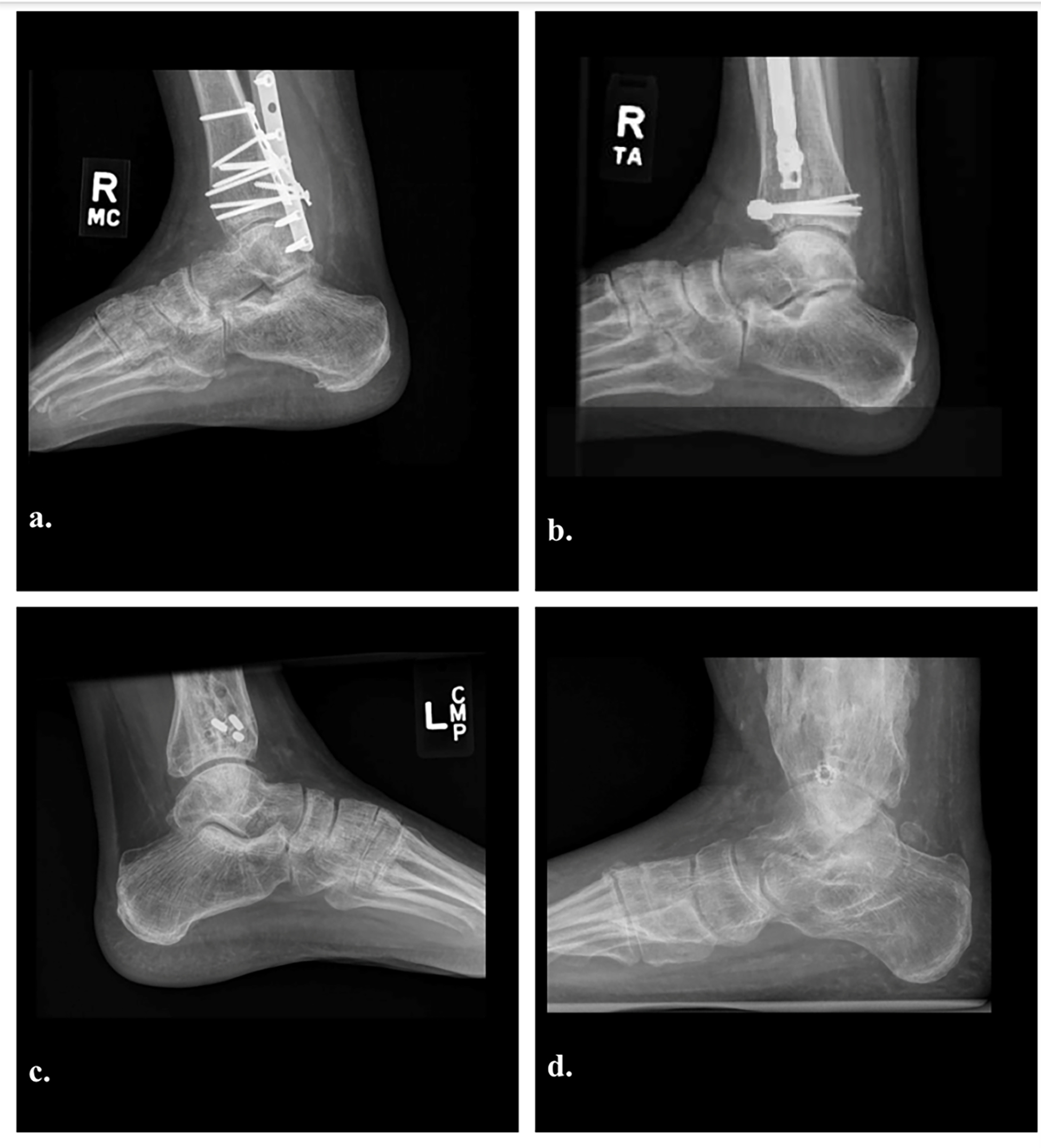
In this post, Surbhi Srinivas, BS and Raveena Joshi, BS reflect on recent findings regarding the development of subtalar arthritis after open reduction and internal fixation (ORIF) of an acute pilon fracture. They are among the authors of a study now in JBJS: The Prevalence of Subtalar Arthritis Following Pilon Fractures. This post is part of our new “Author 360” series on OrthoBuzz, offering author insights and perspectives on featured JBJS content.
Pilon fractures are among the most challenging injuries we treat in orthopaedic trauma. Caused by high-energy axial loads, these fractures can be devastating to the ankle joint and are well known for their high risk of posttraumatic ankle arthritis. What has been far less clear, however, is how these injuries affect the subtalar joint, and what treatment options most effectively mitigate further damage.
This question has become increasingly important as acute hindfoot nailing (tibiotalocalcaneal arthrodesis) gains traction as an index treatment option for highly comminuted pilon fractures, particularly in older patients. While open reduction and internal fixation (ORIF) can be successful for fracture realignment and healing, there still exists a risk for posttraumatic ankle arthritis because of articular damage.
In our study, including 473 patients, our research team aimed to retrospectively study the prevalence and severity of posttraumatic subtalar arthritis in patients who underwent ORIF for pilon fractures. Radiographic evidence of subtalar degeneration appeared relatively early and increased with time from injury. Importantly, multiple patient-related factors, such as age, smoking status, steroid use, comorbidity burden, fracture severity, and time since injury, were significantly associated with arthritis severity. Read the study.
What stood out to us was not just the prevalence of subtalar arthritis, but what it suggests about the natural history of pilon fractures. Even when the subtalar joint is not directly targeted during initial treatment, degeneration appears to develop over time, likely due to a combination of initial cartilage injury and altered biomechanics following ankle motion loss. In this context, the concern that acute hindfoot nailing uniquely compromises the subtalar joint may be less compelling than previously assumed.
These findings do not suggest that one surgical approach fits every patient. Rather, they emphasize the importance of individualized decision-making, particularly in the geriatric population or among patients with limited functional demands, where the benefits of a stable, plantigrade foot and earlier mobilization may outweigh theoretical risks. Ultimately, understanding how pilon fractures affect adjacent joints helps us better counsel patients, set expectations, and refine treatment strategies. As surgical techniques evolve, appreciating the injury’s natural progression is just as critical as the procedure itself.
 Surbhi Srinivas, BS is a medical student at Northeast Ohio Medical University and a research intern with the Foot & Ankle Research and Innovation Lab at Mass General Brigham and Harvard Medical School.
 Raveena Joshi, BS is a medical student at Virginia Commonwealth University School of Medicine and a research intern with the Foot & Ankle Research and Innovation Lab at Mass General Brigham and Harvard Medical School.
Read the study and access the video summary at JBJS.org: The Prevalence of Subtalar Arthritis Following Pilon Fractures
Additional perspective on this study is provided by Sheldon S. Lin, MD in a new commentary at JBJS.org: Development of Contiguous-Joint Arthritis After Pilon Fracture

